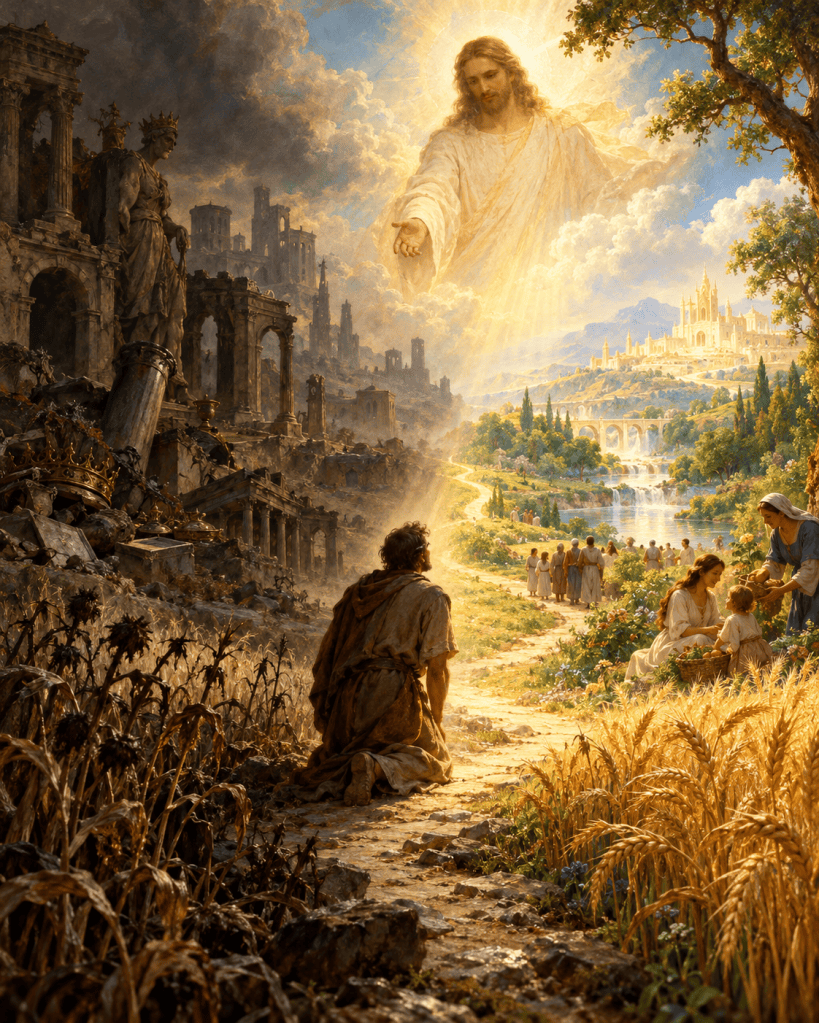
We live in a time of transition, between a world shaped by survival, focused on materiality—a human, animal reality, full of pride and selfishness—and a completely new world, shaped by love, truth, humility, and solidarity, a subtle reality where a new paradigm of spirituality reigns.
Not everyone will be permitted to be an inhabitant of this new world. From this arises the beautiful allegory of the wheat and the tares.
The wheat and the tares will have different destinies: the wheat will inherit the New Earth: “Blessed are the meek, for they shall inherit the earth.” — Matthew 5:5.
And the tares will be taken away, cast out: “The Son of Man shall send forth his angels, and they shall gather out of his kingdom all things that cause offense, and those who commit iniquity. And shall cast them into a furnace of fire…” — Matthew 13:41–42.
Reaching heaven is not about accomplishing extraordinary deeds; it is fundamentally a grace. But it requires a certain disposition from us. It is about choosing what is right and not what is improper.
It is not about appearing good, it is not about keeping up appearances or having a record worthy of prestige. It is born from something much simpler, but far more important: choosing courage instead of fear, choosing humility instead of ego, choosing gratitude instead of sadness, faith instead of anxiety, understanding instead of hatred.
It is about recognizing that, in ourselves, we are insufficient to attain all these things on our own. It is about recognizing our imperfection and our sinful nature.
But it is also about recognizing that, through our complete surrender and personal devotion, by means of a continuous, loving relationship with the divine presence of Christ, we will attain mercy and overcome evil with good, not by our own strength, but by the strength of Christ within us.
And thus we will be able to overcome fear with courage, overcome ego with humility, overcome sadness with gratitude, overcome anxiety with faith, overcome hatred with understanding, and each time we will be closer to perfection, living through love.
“Therefore, be perfect, as your heavenly Father is perfect.” — Matthew 5:48.